
1. Comprehensive overview of the project
CRMsDataSpace is an ambitious initiative to establish the first Common European Data Space on Critical Raw Materials (CRMs) for the Green Deal, focusing on the recovery potential of CRMs from closed extractive coal waste facilities across Europe. The project responds to the objectives of the Critical Raw Materials Act (CRMA) and contributes to strengthening the European Union’s strategic autonomy, industrial competitiveness, and green transition.
The project combines expertise from mining sciences, digital technologies, artificial intelligence, and data governance to create a secure, interoperable, and trustworthy ecosystem for sharing and exploiting critical raw materials data. By deploying a Minimum Viable Data Space (MVDS), CRMsDataSpace will facilitate data exchange among stakeholders, including mining companies, public authorities, geological surveys, research organisations, and technology providers.
CRMsDataSpace will also pioneer the application of Artificial Intelligence (AI) and Large Language Models (LLMs) within the critical raw materials sector. AI-powered reporting tools will automatically generate thematic reports to help project promoters, policymakers, investors, and researchers identify recovery opportunities, assess economic viability, and explore strategic supply chain options. In parallel, a novel AI-based classification tool will support the categorisation of CRM projects in accordance with the United Nations Framework Classification for Resources (UNFC), thereby facilitating compliance with emerging European regulatory requirements.
D1.3 Comprehensive Overview of the Project
2. Communication and Dissemination Plan
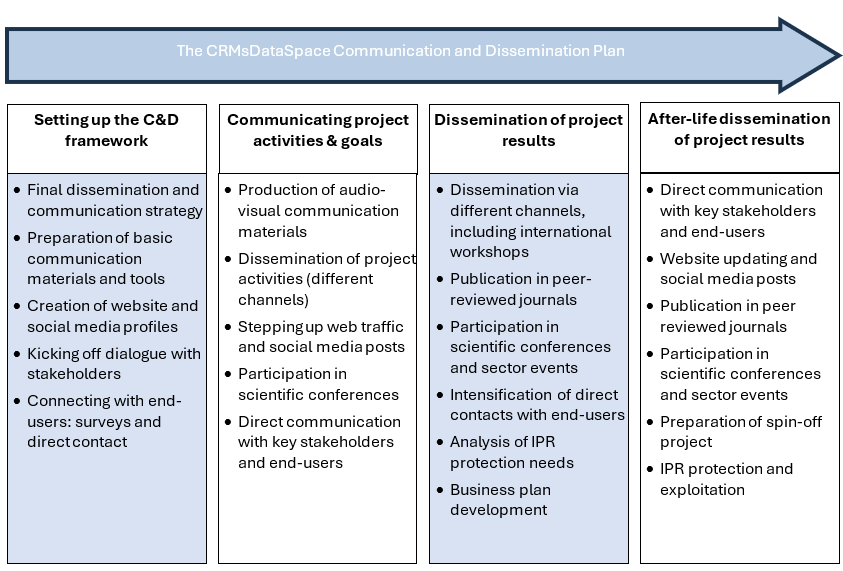
The CRMsDataSpace communication strategy enables broad awareness and stakeholder uptake of the project results through a range of communication and dissemination tools, such as a dedicated website, informative videos, bi‑annual newsletters, publication of scientific publications, specialised webinars, international workshops in the partner countries and a final Brussels event.
This plan defines the objectives, audiences, governance, channels, activities, calendar, performance indicators and risk management for CRMsDataSpace communication, dissemination and stakeholder engagement. It covers project‑wide actions aligned with CRMA implementation, FAIR data principles and the specific tools of CRMsDataSpace (data space platform, GIS web portal, mobile app, LLM‑based reporting, UNFCR classification).
D1.4 Communication and Dissemination Plan
3. Closed extractive coal waste facilities information
Closed and transitioning coal waste facilities across Europe can be systematically documented as potential secondary sources of critical raw materials, provided that geological, environmental, operational and access-related information is collected in a structured and comparable way.
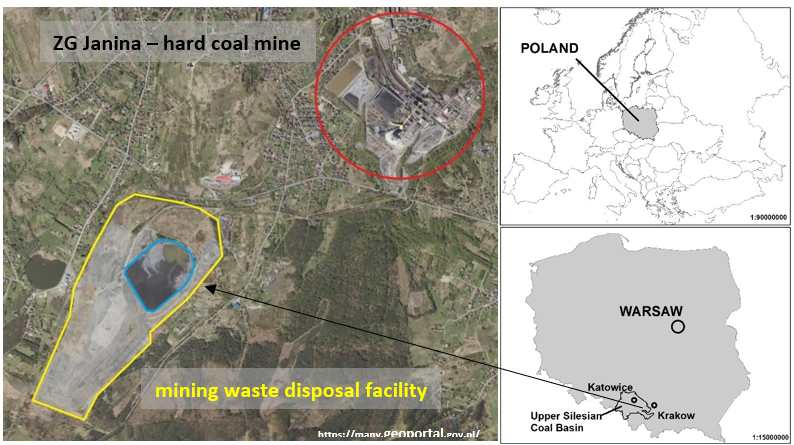
The project establishes this baseline for five contrasting case studies in Romania, Poland (2), Spain, and Germany, thereby laying the foundation for the next project stages: detailed mineralogical and geochemical characterisation, metallurgical testing, resource estimation, and integration into the CRMsDataSpace.
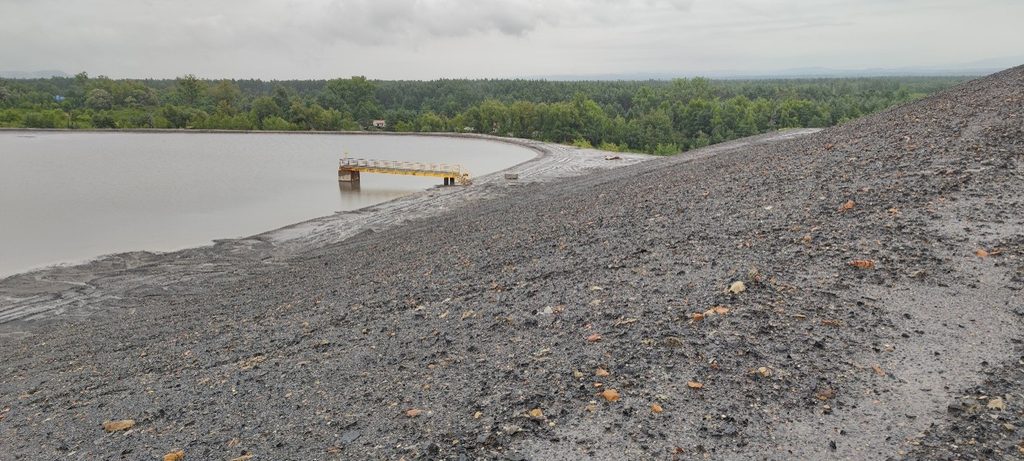
Technical characterisation must go beyond simple site identification. Useful baseline knowledge includes accurate geometry, deposit extent, historical development, waste typology, sampling strategy, ownership and legal status, hydrogeological conditions, and environmental constraints.
D2.1 Closed extractive coal waste facilities information
The lessons learnt from this Deliverable are as follows:
- Even when facilities originate from the same broad sector, their material properties, environmental behaviour and redevelopment constraints differ markedly. This means that no uniform methodology based only on desk research or generic assumptions would be sufficient.
- Environmental and geotechnical factors must be addressed from the outset. The document shows that recovery potential cannot be assessed independently from slope stability, water interactions, oxidation processes, and reclamation status.
- Good geometry and sampling design are essential. A reliable resource assessment starts with knowing where the material is, how it is distributed, how thick it is, and how variable it may be both laterally and vertically.
- Reclamation and valorisation can be complementary. The practical implication is that closure planning should preserve, whenever possible, the information and access conditions needed for future resource evaluation.
- Post-mining residues extend beyond classic spoil heaps. This is significant because it suggests that future inventories of CRM-bearing coal legacies should include fine residues, sludges and treatment by-products, not just traditional waste dumps.
4. Chemical and mineralogical characterisation
5. Mineralurgical and hydrometallurgical recovery
6. Multihole exploration drilling
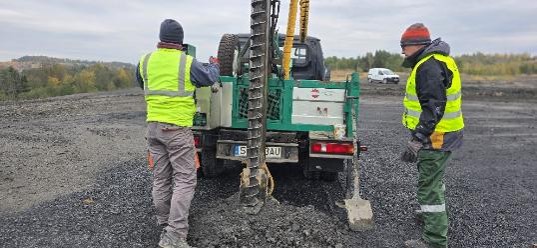
This deliverable presents the multihole exploration drilling, sampling and laboratory characterisation activities carried out at two coal mining waste facilities: the San Nicolás waste dump in Asturias (Spain) and the Janina facility in Libiąż (Poland).
The main objective was to establish an initial geological and geochemical dataset to assess the presence, concentration and spatial distribution of Critical Raw Materials (CRMs) in these deposits, providing the technical basis for evaluating their potential as secondary raw material sources.
The exploration campaign comprised seven boreholes at San Nicolás, representing approximately 95 m of drilling and 21 representative samples, and three boreholes at Janina, from which 12 samples were reported. Different drilling techniques were used based on each site’s characteristics, demonstrating the importance of adapting exploration procedures to the heterogeneous and often unconsolidated nature of mining waste deposits.
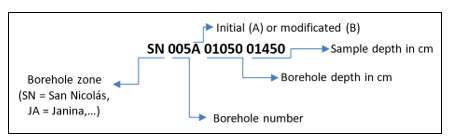
Sampling was performed at approximately 5 m depth intervals, consistent with the spatial resolution envisaged for subsequent three-dimensional modelling. Standardised borehole and sample identification procedures, together with geographical and photographic documentation, ensured traceability and facilitated data integration.
D2.4 Multihole exploration drilling
The lessons learnt from this Deliverable are as follows:
- The experience at San Nicolás demonstrated the importance of maintaining flexibility in borehole positioning and drilling procedures, while the auger drilling system used at Janina proved appropriate for recovering material from relatively shallow and unconsolidated deposits.
- Regular depth intervals facilitate comparison of analytical results and their integration into geological models. The approximately 5 m sampling intervals adopted in this investigation were selected to correspond to the spatial resolution envisaged for 3D modelling.
- Implementing a common identification system for boreholes and samples proved particularly valuable for managing the information generated at the two investigation sites.
- The differences observed between boreholes and depth intervals, particularly at San Nicolás, confirm that coal mining waste deposits cannot necessarily be treated as chemically homogeneous materials.
7. Resource estimation
8. High-level data model conceptual design
This deliverable establishes the foundations for the data catalogue dedicated to critical raw materials (CRMs), aligning with EU regulations, standards and interoperability frameworks. Since this is an early stage, the design should be considered a preliminary version subject to expansion and refinement as the project progresses.
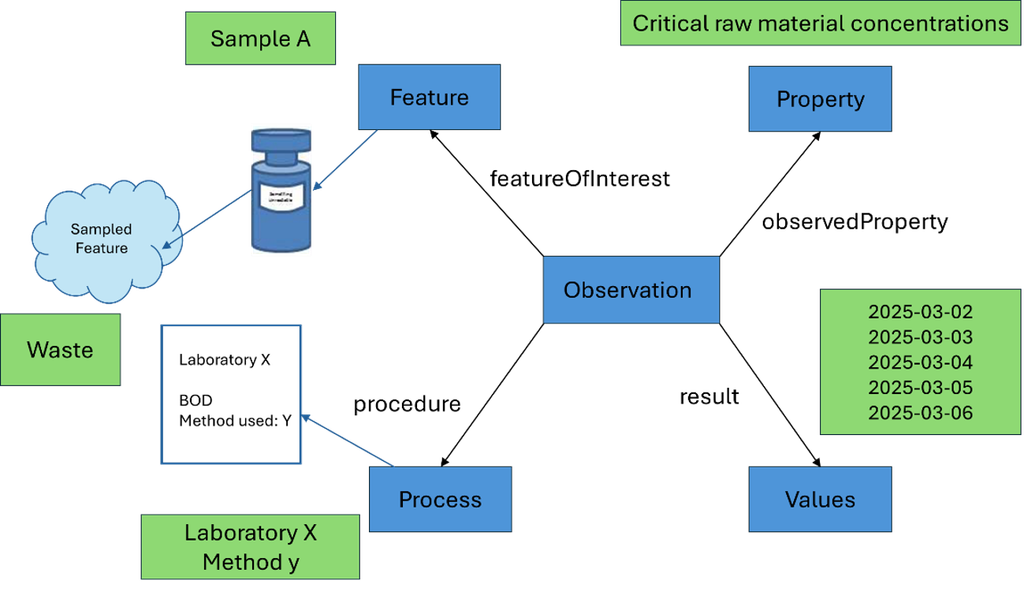
The data model is developed after a thorough review of widely used standards and European regulations (INSPIRE Directive, ISO 19100 family, European Data Strategy and the Critical Raw Materials Act, among others). It defines fundamental data concepts while introducing a metadata profile aligned with ISO 19115 and DCAT-AP. The design is informed not only by normative frameworks but also by real-world sample datasets from waste deposits, thus ensuring its applicability to operational contexts.
The conceptual design outlined covers the following key components: (1) A reference model for semantic interoperability and standardized terminology; (2) A data lifecycle from gathering and transformation to cataloguing, sharing, and consumption; (3) Controlled vocabularies and ontologies to ensure semantic consistency; (4) Preliminary international benchmarking against current initiatives on CRMs recovery; (5) Dependencies with related project tasks to ensure continuity from conceptual design to implementation, quality assurance, governance, and platform development.
D3.1 High-level data model conceptual design
The lessons learnt from this Deliverable are as follows:
- The adoption of established European and international standards (ISO 19100 family, INSPIRE, DCAT-AP, OGC frameworks) is essential to ensure semantic and technical interoperability across domains. Nevertheless, these standards may require extensions or contextual adaptations to properly capture the specificities of coal waste deposits and secondary raw materials.
- While standards guarantee comparability, strict adherence can create rigidity. Flexibility must therefore be incorporated into the model to accommodate evolving technologies, heterogeneous data, and local variations in waste characteristics.
- The conceptual model must also be grounded in real-world datasets, both from legacy and newly collected field data. This empirical evidence provides validation of abstract structures, reveals edge cases, and ensures the model’s relevance in operational contexts.
- This design is a first version, intended to evolve as requirements, standards, and available data mature. Stakeholder feedback and ongoing technical input will be crucial to align the model with project goals and external initiatives.