Recovering critical raw materials from extractive waste facilities can create economic value and employment in historical mining regions, explicitly supporting the just transition of the coal sector and regions highly affected by deindustrialisation and decline.
The European Critical Raw Materials Act, enforced on 23 May 2024, aims to ensure a sustainable and secure supply of critical raw materials for Europe’s industry. It mandates each Member State to establish a database containing all relevant information to promote the recovery of critical raw materials in closed extractive waste facilities. The information in the databases should be publicly available in a user-friendly digital form, allowing potential project promoters to quickly identify facilities with a high potential for economically viable recovery.
It can be anticipated that Member States will rely on existing databases, such as those from national geological services or Europeanwide EU projects. However, these databases were not originally designed for the purposes of the Critical Raw Materials Act. This mismatch in objectives, systems and languages could lead to significant barriers for companies interested in recovering critical raw materials from these sites while preventing comparisons at the European level.
CRMsDataSpace’s main objective is, based on the coal industry, to start building a Common European Data Space on critical raw materials for the Green Deal, currently inexistent, which will allow data to be shared and made available in a trustworthy environment, creating multi-sided business solutions that leverage network effects, catering to both the “supply” and “demand” of data, and creating data-related services. This will attract users not only from the coal industry but from the mining industry in general, with the understanding that a large user base will, in turn, engage additional data resources and services.
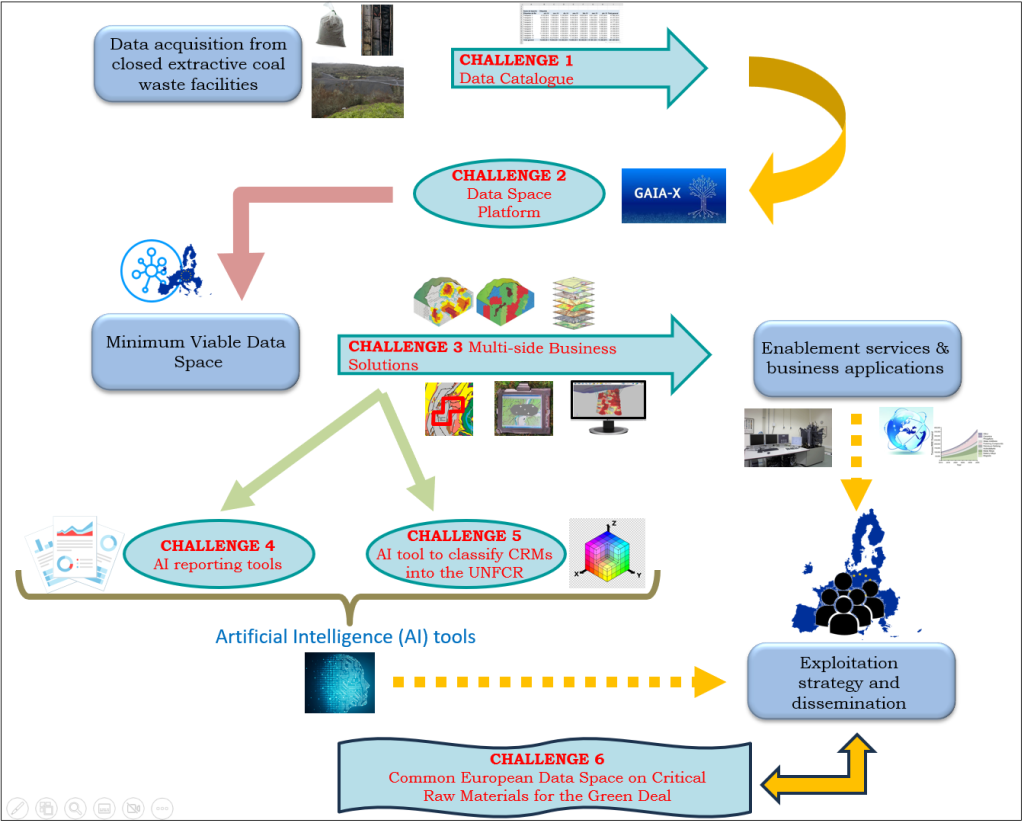
The CRMsDataSpace overall methodology is as follows:
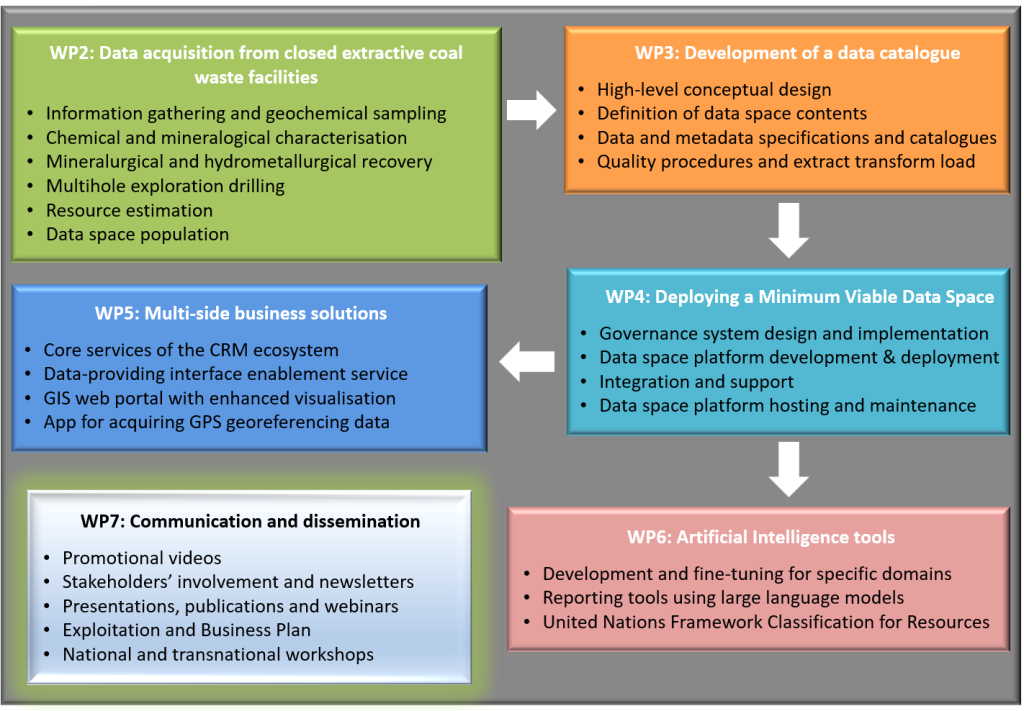
The CRMsDataSpace Project is structured into seven Work Packages (WPs) to develop its methodology. Apart from WP1 that addresses the project’s coordination and management, the rest are presented here: